Our Aviary
Background
These photos represent the final incarnation of the main aviary that was started
around 2000. It has gone through a surprising number of changes over the years. Being a large space gives you the opportunity to adapt it as circumstances change and also to try out new ideas to see how they work.
Each year a fresh situation arises or a new insight suggests modifications that might improve things. As well as birds, it has also been the home to chipmonks who not only built a burrow, they also bred. However, keeping them in was always a challenge and they were a source of disruption for the smaller birds - the finches etc.
No matter how things have unfolded, the one overwhelming problem with the space is how to catch the off-spring of successful parents so that we can manage the populations. This has always been a stressful process for both us and them and, whilst we have developed some more effective techniques, the end result is always frayed tempers and exhausted birds.
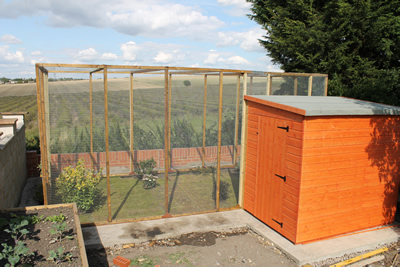
In 2014 I began the building of 3 smaller aviaries. Each will measure 5m by 3m by 2.4m high. And each will be attached to a shed. This will provide 2 functions. Firstly, it will act a double door for entry and exit. Secondly, it will provide heated shelter for the more delicate inmates.
The first of these is pictured below and it's development is shown in the section called Design. It is planted with young shrubs and turfed, although we have left a section of bare soil both for dust-baths and for them to grub around. On the left side is a passion fruit planted on the outside so that it is not eaten as it develops. The shed is divided internally so that it provide access for us as well as a retreat for the birds.
I am planning to install a solar panel on the roof of the shed to provide heating throughout the winter - more on this as it develops.
The Aviary - Description
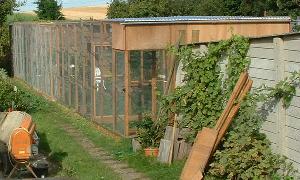 |
The aviary measures 19m by 3.8m by 2.5m (64ft x 12 ft x 8ft). It consists of a long run of 16m and a short section 3m long. Each end has a 1.8m length of clear roof and is boarded on three sides. There is also a small roofed section in the mid-part of the run which also provides some shelter. |
| The aviary is well planted with grass, shrubs and trees but the birds still have a sizable flight available to them (16m). So far, I have had to re-seed the grass each spring (or lay turf) as the pheasant and quail in particular eat it throughout the year. Presently, the Monals, with their strong, hooked beeks and powerful legs dig the ground remorselessly. We always keep areas grass-free, however, as the quail in particular enjoy dust baths and, as the temperature drops in the autumn, they semi-bury themselves in the warmer sub-soil. | 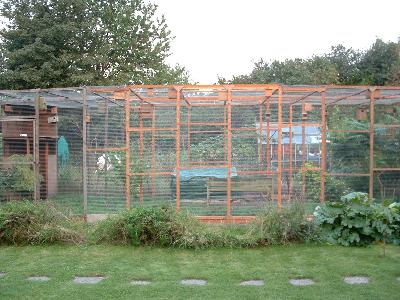 |
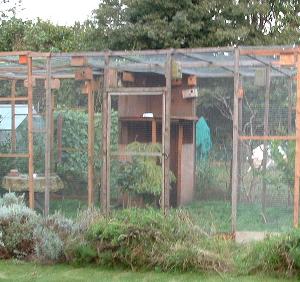 |
There is plenty of shelter at either end of the aviary and a small section here in the middle offering an alternative. This also provides another feeding area in bad weather. However, many birds ignore this and prefer either to sit out in the rain or use the shrubs and trees for cover. |
| There is a double door at both ends of the aviary. This one leads first into the short sub-section which has a door into the main run. | 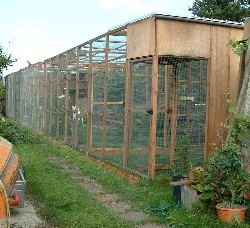 |
 |
This second, recently built (2014) aviary represents the adoption of the good points of the main aviary. We have hopefully learned from our mistakes and experiments and are now creating not only good environments but also easily maintained environments. The proof will come after the first winter when we will a) find out how it and the birds have withstood the weather and b) when we find out if any of the birds show any inclination to breed. |