We have also tried to ensure that breeding opportunities are present for everyone.
With the original large aviary we didn't provide heating of any kind. Every species needed to be hardy. In the new aviary we will maintain a frost-free and sheltered space for those more delicate species. We will monitor how this is working.
 From very small beginnings involving a few chickens and a guinea
fowl, we have now built quite a large and varied community. The emphasis is
now on providing an environment suitable to a wide variety of species and
giving them sufficient space both for their own needs and to ensure that they
do not encroach on each other.
From very small beginnings involving a few chickens and a guinea
fowl, we have now built quite a large and varied community. The emphasis is
now on providing an environment suitable to a wide variety of species and
giving them sufficient space both for their own needs and to ensure that they
do not encroach on each other.
I tend to think of the aviary as a three dimensional space occupied as follows:
- in the bottom 15% are predominantly the quail, partridge and pheasant although many birds prefer to feed off the ground rather than from the pots.
-
In the upper 85% are the parakeets, the touracos and the larger bulbuls.
-
Interspersed with these and filling in the gaps are a variety of finches, doves, minlas and so on.
Each of these 3 sections has to work together, which is the relatively easy part. The only real conflict between the sections occurred last year when the female touraco was nest-building and sitting on eggs. She became very aggressive and destructive towards any chicks born at that time and we lost a chinese painted quail brood, a mountain bamboo partridge brood and the chestnut-winged minla chicks. If she shows signs of a similar tendency this year we will attempt to separate her from the community.
 Getting each section to work on its own is much more difficult
particularly as the character of the birds varies with their surroundings.
For instance, subservient male quail can change completely if the dominant
male quail is removed. There are also likely to be conflicts over nest boxes
or nest sites between similar types of bird which have similar requirements.
The zebra finches, for example, can be very destructive towards the nest boxes
of other finches.
Getting each section to work on its own is much more difficult
particularly as the character of the birds varies with their surroundings.
For instance, subservient male quail can change completely if the dominant
male quail is removed. There are also likely to be conflicts over nest boxes
or nest sites between similar types of bird which have similar requirements.
The zebra finches, for example, can be very destructive towards the nest boxes
of other finches.
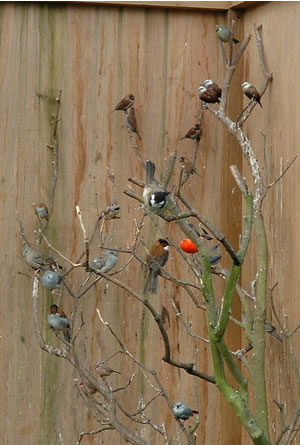
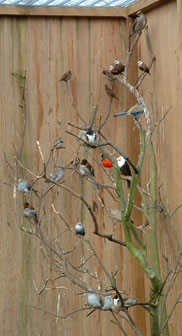
At the present, though, we seem to have a particularly equitable bunch. This is more by luck than good judgment as far as choice of bird goes. However, the size and variety of the habitat and the ample provision of food, roosting sites and nesting opportunities also has a lot to do with it. As can be seen from the stills and the video clips, most birds are content to get along with just about everything else.
Whilst we have always concentrated on provided a wide variety of plant life and try hard to ensure that the aviary floor is grassed, the quail, partridge and pheasant have always sought to denude sections. This is because during warm weather they luxuriate in dust baths. Unfortunately, they bathe in strong sunlight making them difficult to photograph!